

Photo by Christian Lue on Unsplash
It’s long been known that people throughout history have had unwanted thoughts that are out of character. Margery Kempe shared courageously about such thoughts in what is hailed as the first autobiography in English. She would mentally experience intrusive images of men’s genitals—both of clergy and other people she came across. She was terrified of these thoughts that plagued her mind.
Martin Luther experienced unwanted urges to curse God and intrusive mental images of the Devil’s butt.
Winston Churchill stood back from train platforms and the edge of boats for fear a “dark impulse” would come over him:
I don’t like standing near the edge of a platform when an express train is passing through. I like to stand back and, if possible, get a pillar between me and the train. I don’t like to stand by the side of a ship and look down into the water. A second’s action would end everything. A few drops of desperation.
Yes, it’s well documented that Churchill struggled with depression, so you might assume he was fighting urges to kill himself, but the way he describes these examples is the fear of doing something unwanted rather than the risk of giving in to an urge he expresses a wish to do.
Herein lies the key distinction in much of what I work with: whether a thought, urge, image, feeling, or sensation is congruent with how a person believes, acts, and ultimately wants. If the starting point is “I don’t want this to be here,” we call that egodystonic, and it’s a hallmark of the diagnosis of OCD.
Normal Stuff
Purdon and Clark (1993) found that over 90% of people endorse a wide range of intrusive thoughts, urges, and images, including:
Sex/acts:
With an unacceptable person
With an authority figure
Of a different sexual orientation
In public
Of a disgusting nature
Fly/blouse undone, exposing oneself, naked authority figures
Getting an STD
A great compilation list can be found at the Oxford Cognitive Therapy Centre.
A great lay guide, compiled by the author, Kati Lynn et al., is “a list of almost 200 intrusive thoughts that might make you less scared of your brain.”
As I often say, you can have any thought or feeling anywhere, any time, and for almost any reason. Those reasons don’t have to be bad; it doesn’t mean you’re struggling with addiction or trauma or even sin to have these experiences. Sometimes wires get crossed, our brain throws us a curveball, or we’ve made an association of something that doesn’t mean what it seems like.
Why Can’t We Accept Out-Of-Context Arousal the Same as with PTSD?
Sexual intrusions are intrusive. Unwanted. They don’t reflect a person’s life or character necessarily. In my line of work, this is an established fact. I’ve never in my 20 years of providing therapy heard anyone shame a person who was a victim of sexual abuse or violence for having their unwanted thoughts, feelings, or sexual urges. Quite the contrary, there is an almost implicit acceptance and compassion because there’s an obvious cause for why. A tremendous evil has been done to someone. God sees this. He abhors it. God will bring justice and hope (Psalm 37:28; Isaiah 30:18).
When people have anxiety disorders or OCD, they can experience similar misfires of the brain and body that can easily be described by science and faith—if we have ears to hear.
A variety of thoughts and feelings arise in the human experience, both those that fit our desires or character and those that don’t. Christian doctrine tells us that there are both unseen spiritual dynamics and impacts on our physical world due to what is called “the Fall,” or man’s descent into trying to run the show and play God. Some effects of sin are direct and immediate consequences of our personal wrongdoing, such as having an affair. Others are indirect impacts on someone that are unfair and unjust, such as a child growing up without their father or being abused by them.
When the Heart Doesn’t Match the Brain and Body
Okay, let’s get even more bold. Have you ever had a sexual feeling or sensation that you didn’t desire? I’m not talking about suppression, which happens a lot in Christian circles (e.g., finding someone attractive and then trying to push that thought or feeling away). What I’m talking about here is something akin to arousal nonconcordance: a genital response that doesn’t match sexual arousal.
Teenage boys know this feeling quite well when they get an erection in early adolescence in the car around their family or randomly in school. According to research, women have way more of these experiences than men (Álvarez-Muelas et al., 2022), though men have the more “obvious” equipment, shall we say, that highlights all the awkwardness here.
Victims of sexual assault often feel guilty if they experienced even a fleeting moment of a pleasurable feeling. Expert clinicians know this happens—it says nothing about that person’s actual wishes or desires, effectively. If anything, it reflects the opposite of what they want.
Sexuality can have tons of shame already for anyone, and unfortunately, we as Christians can sure heap a lot on. For the person who has experienced trauma, I think the church is very quick to understand and patiently encourage that the results of this broken world are fierce. Can we do the same with OCD? Anxiety Disorders? The “average Joe” who has thoughts like this? I will be the first to say that a diverse range of unwanted thoughts exists in upstanding, integrity-filled leaders, pastors, executives, stay-at-home parents, counselors, men, women, children, teens, adults, Christians, non-Christians, over-achievers, “Type B” personalities, etc.
Unfortunately, Be Careful What You Share With Others
Be intentional with whom you talk about this, but find someone to talk with. If you have looping intrusive thoughts, especially sexual ones, like Margery Kempe or Martin Luther, there is hope, and freedom is found in community. However, be wise about whom you discuss with, because there are those who heap burdens on you.
Trusting in a treacherous man in time of trouble is like a bad tooth or a foot that slips.
~Proverbs 25:19
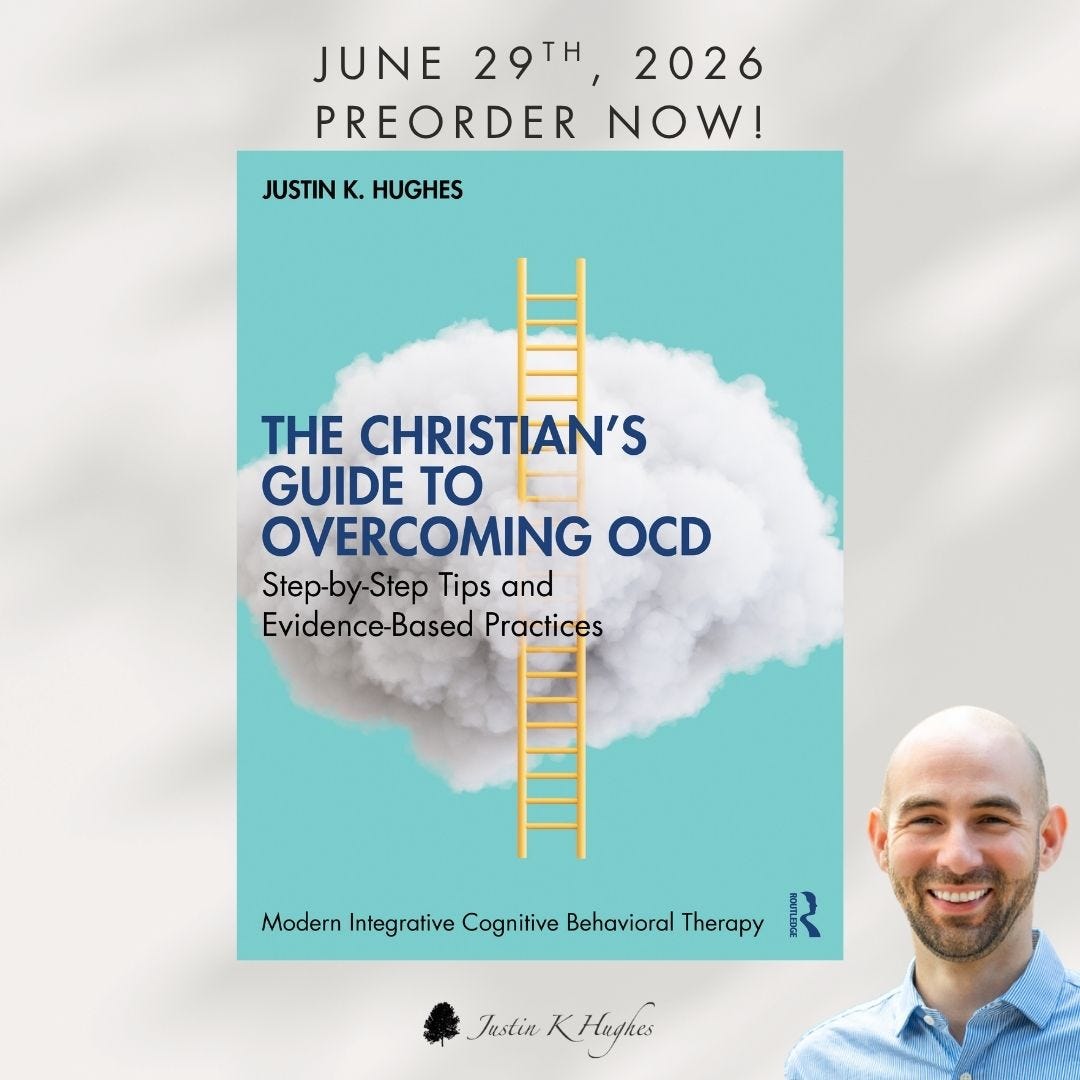
I have provided explicit guidance and worksheets for how to communicate and be in community when you are suffering from these things in Chapter 12 (“Thriving in Community)” of my new book, The Christian’s Guide to Overcoming OCD.
Amelia shared with me the desire to connect more and be known in her church. I wish I could say, “Good for you! Lean into that courage,” as a first thought. But rather, I first helped her prepare for these conversations—and for spotting untrustworthy people.
Don’t hear me wrong: as someone who believes in the full counsel of God’s word, being a part of the church is critical, and I would never discourage that in an ultimate sense. However, I also draw on all the wisdom of the Scriptures: don’t entertain fools (Proverbs 14:7).
I don’t know what the average experience is like in the church when sharing intrusive thoughts, but I know for many I talk to, it ain’t pretty. Amelia had both good and bad experiences. In the realm of unacceptable intrusive thoughts (often called “taboo thoughts” or “Pure O” OCD), I hear person after person experiencing both acceptance and encouragement, but often invalidation, minimization, and heaps and heaps of shame.
Context, Context, Context
Context is key—in anything. If someone tears up, I don’t assume they are sad or crying. People experience tears due to contact lens malfunctions, dry eyes, or even when practicing deep breathing.
A good clinician, friend, or minister will ask questions, slow down, and be wary of rushing to judgment. I hope you have this experience.
Trading Shame for Mercy
As our Lord has taught us to love one another (John 13:34), patience is needed with everyone. I sure hope the church shows you patience in your own suffering—like I’ve experienced personally in innumerable. The Church is flawed because we are still a work in progress. But we are Christ’s work. I pray for patience with those who don’t show understanding. I sure hope mercy can be shown more for those suffering from intrusions. I just hate it when someone is in a weak, vulnerable state, and they are the ones receiving added pain. Yet, we must press into forgiveness that is not based on fairness; it’s based on the truth and hope of the Gospel available to all who believe (Romans 1:16).
If you suffer from unwanted thoughts—sexual, violent, blasphemous, looping, or any other—you are seen. There is hope greater than what you feel right now.
Looking for hands-on guidance and exercises? Get my book on June 29th: “The Christian’s Guide to Overcoming OCD.” It covers the history of OCD (and how the church has responded), personal experiences, and the science and practice of treatment with a focus on Jesus. SPOILER: some faith leaders hundred of years ago had better responses than many do today.
If you are the person on the outside who thinks this sort of thing seems odd, thanks for reading and maybe considering how to love others well, even if this is strange to you. If we learn only how to help 2-3% of the world who suffer from something like OCD, that’s a big deal, because to them, it’s one of the most difficult things they ever experience in life. But the research reveals a bigger picture: it’s closer to 98% of the world with some of these types of thoughts. Let’s meet the fear and shame with hope and kindness.
Have mercy,
~Justin
*The examples used in this post involve composites of very real symptoms and suffering, despair, and hope. The information doesn’t identify any specific individual. Content is not intended as a substitute for professional advice, treatment, advice, or diagnosis. Where applicable, seek the advice of your own personal health provider or faith leader who is qualified to care for you, along with asking them any questions you may have. Never disregard professional medical advice or delay in seeking it because of something you have viewed through educational or self-help content.
This is such an important thing to write about, Justin. Thank you for helping to bring this experience to the light for so many who are suffering in the dark ♡